
What does OSHA's silica standard require?
Under OSHA's silica standard, a worker's breathing air can hold no more than 50 micrograms of silica dust per cubic meter, averaged across an 8-hour shift. Employers must limit exposure, but testing and medical exam duties depend on the work: construction employers can follow OSHA's Table 1 controls instead of measuring exposure, and medical exams depend on how many days a worker is exposed or must wear a respirator. A microgram is just one millionth of a gram, and these particles are at least 100 times finer than typical beach sand. The rule exists because this dust leads to silicosis, an incurable lung disease, and it also makes lung cancer, COPD, and kidney disease more likely.
- a year at the action level brings free medical exams
- 30 days
- a repeat medical exam, or sooner
- Every 3 years
- to tell construction workers their test results
- 5 working days
- construction rule fully in force
- September 23, 2017
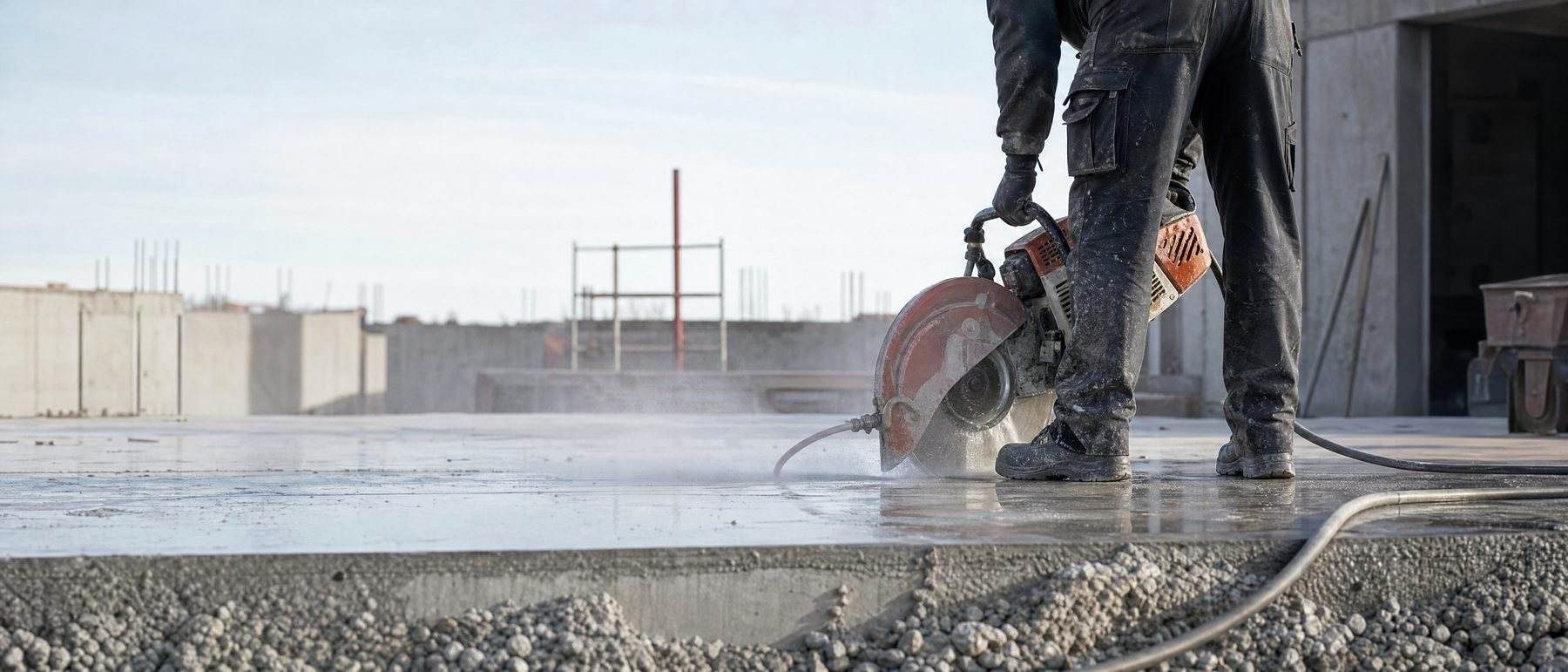
Which OSHA silica rule fits your work?
OSHA has two standards: one covering construction and another for general industry and maritime work. Construction falls under 29 CFR 1926.1153, which employers had to follow in full by September 23, 2017. General industry sites such as shops, plants, foundries, and stone countertop workshops are governed instead by 29 CFR 1910.1053, the rule for general industry, which came out on March 25, 2016.
Both standards deal with respirable crystalline silica. That means fine dust from quartz and two related minerals that workers release into the air by cutting, sawing, grinding, drilling, or crushing stone, rock, concrete, brick, block, or mortar. Sandblasting, foundry work, fracking sand, and stone countertop production or finishing all create this dust.
The construction rule covers any job where dust could climb to 25 micrograms per cubic meter in conditions that could foreseeably arise. In general industry, OSHA treats a broken dust collector or ventilation system as something that can be expected to happen, so an employer can't use readings taken while the equipment works to claim the rule doesn't apply. States running their own safety programs have to match OSHA at minimum, and may be stricter.
The exposure limit and the action level
Both key numbers are identical in construction and general industry. Both are averages over an 8-hour shift, so a short burst of heavy dust gets spread out over the whole day when it's measured.
| Line | Level in air | What this level requires |
|---|---|---|
| Legal exposure cap | 50 micrograms per cubic meter, averaged over 8 hours | Exposures above this are not allowed. The employer has to lower the dust. |
| Action level | 25 micrograms per cubic meter, averaged over 8 hours | Air testing and medical exam duties can start at this level. |
That action level sits below the legal limit, and it is the lower trigger that turns the employer's duties on. Quick tasks get no pass, not even 15 minutes a day. For a brief 15-minute burst of dust to average out to the action level across a shift, the air in those minutes would need to hold more than 800 micrograms per cubic meter. Jobs such as abrasive blasting and grinding countertops made of engineered stone can hit levels that extreme.
Testing the dust and sharing the results
If workers might reach the action level, the employer has to sample the air, either with scheduled monitoring or by turning to other solid data on the same kind of work. Results above the limit call for another test within 3 months. Results between the action level and the limit call for another test within 6 months. Testing can only end after 2 results, at least 7 days apart, that both fall below the action level.
You are entitled to see what the tests found. In construction, workers who are affected must be told in writing or through a posted notice within 5 working days; the window for general industry employers is 15 working days. Employers also have to keep records of air samples and medical checkups.
Controlling dust on the job
Any construction employer covered by the rule must put together a written exposure control plan naming the tasks that throw off dust, the methods used to hold it down, and how entry into dusty zones is restricted. A competent person, someone the employer assigns to run the plan, has to manage it. Employers in general industry have to look over their plan at least once a year.
Construction firms have a choice: follow Table 1, which pairs common tasks with the exact controls OSHA will accept, or test the air and pick controls themselves to stay below the limit. Water running over a saw blade cuts the dust substantially. Tuckpointing grinders call for a dust collector whose filter is at least 99 percent efficient, and indoor work with handheld power saws requires a respirator no matter how short the job. Anywhere respirators are required, the employer has to operate a full respirator program.
Cleanup matters as well. Dry sweeping or brushing is banned wherever it might send silica into the air, unless using water or a HEPA vacuum isn't feasible. To qualify as HEPA, a filter must remove at least 99.97 percent of particles that are 0.3 micrometers across. Workers also need training on which tasks produce silica dust and how to keep it down.
Medical exams at no cost
If the dust you breathe reaches the action level on 30 days or more in a year, your employer has to offer you medical exams free of charge. In construction, anyone who must use a respirator for 30 or more days a year is covered too. These checkups include an X-ray of the chest and a test of how well the lungs work.
Your first exam must be made available no later than 30 days after you start, unless you've had one in the past 3 years. After that, exams must come at least every 3 years, or sooner if the doctor who examines you says so. If a specially trained X-ray reader gives your film a score of 1/0 or higher, a specialist should see you next.
What these rules mean for a claim
OSHA can cite an employer that skips air testing, dust controls, or exams, and the public can see those citations. Public records since August 2019 name 44 employers in 15 states cited for silica dust by OSHA, by Cal/OSHA or by Washington's Department of Labor and Industries. 25 of the cited employers are stone or countertop shops; the others include foundries, brick manufacturers, concrete and masonry companies, and construction contractors. If you think silica dust at work has hurt your lungs, these records can help support a workers' compensation claim. Each state runs its own system, and you can find your state's agency on our workers' compensation page. A law firm that advertises on Silicosis Claims also offers a free claim review by phone, in English or Spanish.